
Why Good Marketing Strategies Fail at the Local Level
We hear it often. Franchisors spend significant time and money developing a strong brand, sophisticated marketing campaigns, digital platforms and local marketing resources. Yet the results aren’t there. Franchisors point to a Franchisee’s inability to execute, and Franchisees to the Franchisor’s inability to understand. Both may be partially right. But rather than getting caught in that back-and-forth, this piece focuses on what the Franchisor can control.
The ultimate performance of that marketing often depends on something much harder for the Franchisor to control: whether Franchisees consistently execute it. This creates what we here at HanTeeKom Group call the Franchise Execution Gap. That’s the distance between the marketing strategy developed at Franchisor level and the Franchisee’s execution of it locally. Is yours a pothole or a chasm?
It is an important distinction because when marketing performance disappoints, the natural reaction is often to revisit the strategy. Well-meaning Franchisors then second-guess themselves. Let’s change the campaign. Let’s develop new creative. Let’s increase media spend. Let’s introduce another technology platform. But none of these may be the problem. The problem may be the system responsible for turning strategy into consistent local execution.
The Structural Challenge of Franchise Marketing
Franchising creates a marketing challenge that most traditional businesses do not face.
A centrally managed organization can develop a marketing strategy and direct its locations to execute it. A franchisor operates differently. It must simultaneously provide enough consistency to build a recognizable brand while enabling independently operated locations to succeed within very different local markets. And while Franchisors can mandate certain execution, in many cases Franchisors may not have complete control.
The International Franchise Association-sponsored ACHQ Franchise Marketing Report (2025) describes the fundamental challenge well: Franchise businesses derive much of their strength from systems that can be replicated across dozens, hundreds or thousands of locations. But their marketing must still feel local to the customer.
That means franchise marketing must accomplish two things at once: scale the system and localize the execution. And that is where execution becomes difficult.
The same ACHQ report suggested that, of more than 250 Franchise marketing professionals, 35% reported a lack of Franchisee engagement with Franchisor marketing initiatives, while roughly 45% identified coordination across locations as their biggest challenge.
Those are not necessarily strategy problems. These are execution problems.
A Marketing Strategy Is Only as Strong as Its Adoption
Consider a relatively common scenario. Corporate develops a new campaign. The positioning is strong. Creative assets are professionally produced. Email templates, social content and promotional materials are made available to Franchisees.
Then execution begins. Some Franchisees use everything. Some use portions of the campaign. Some modify the materials. Some deploy them too late. Some do nothing.
From the Franchisor lens, there is one marketing strategy. From the customer’s perspective, however (remember customers have relationships with the Franchisees but are ultimately buying into the Franchisor Brand), there may be dozens of versions. It may look different in LA than in Seattle than in Phoenix, Philadelphia and Minneapolis.
This is because the Franchisee is often the final mile of the marketing organization. Corporate can generate awareness and demand. It can provide tools and campaigns. But many of the activities that build a business locally — community relationships, local partnerships, events, reputation management, social activity and follow-up — require participation at the Franchisee level.
Franchisees Are Operators First
Corporate Marketing teams at Franchisors, also well-meaning, often make the mistake of assuming that Franchisees are marketers themselves. After all, they must sell and run their own businesses. But in the case of Franchisees, if this was their first inclination, why would they buy into a Franchise?
Most Franchisees are operators and entrepreneurs first. Their days revolve around customers, employees, scheduling, inventory, service delivery, sales and financial performance. Marketing is one of many responsibilities competing for their attention. Not the primary responsibility.
That distinction has significant implications for how a Franchisor should design its marketing system. Franchisors should not design marketing systems for marketers. They should design them for Franchisees.
If executing a campaign requires the Franchisee to understand segmentation, manipulate creative, determine targeting, configure technology and interpret analytics, the organization has transferred too much of the marketing function to the local operator. The Franchisor must do this work to understand the local market and then give the Franchisee enough flexibility to make the marketing locally relevant (see HanTeeKom’s article on Centralized Marketing with a Local Flavor).
Engagement Is Often a Design Problem
Low Franchisee participation is frequently interpreted as a motivation problem. Sometimes. But before reaching that conclusion, Franchisors should ask one tough question of their campaigns: Have we minimized the friction points?
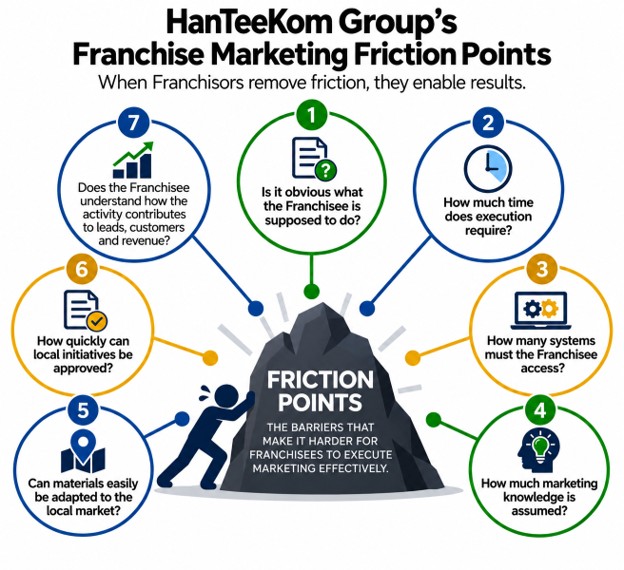
If these friction points are not minimized (reduction is almost impossible), then low adoption should be an expected outcome.
Every additional decision, platform, approval, manual process or technical requirement creates another point at which execution can stop or be heavily delayed.
So, minimizing friction becomes increasingly important as the franchise system grows. A process that works with ten highly engaged Franchisees may not with 50, 100 or 500. Scale exposes weaknesses in campaign design and rollout. According to the International Franchise Association (IFA) in 2026, 44% of Franchisors need 3 to 5 days to execute a single campaign while 18% need more than a week.[1] In highly competitive and/or fast-moving industries, that time to market could mean large opportunity costs.
Standardization Does Not Mean Eliminating Local Marketing
The solution is not to centralize everything.
Franchisees possess something Franchisors cannot easily replicate: proximity to the local customer and often a personal relationship with the customer.
Franchisees know the schools, businesses, neighborhoods, community organizations, events and relationships within their territories. They hear customer objections firsthand. They often understand which services or products resonate particularly well within their markets.
That local knowledge has considerable market value.
The challenge is therefore not choosing between corporate control and Franchisee autonomy. Or put differently, it’s determining what should be standardized, what should be automated and where local flexibility creates value.
Brand positioning, core messaging, visual standards, campaign architecture and major technology platforms may require significant central control. Community engagement, partnerships, events, local stories, customer testimonials and certain promotional activities may benefit from substantially greater local participation.
A well-designed franchise marketing system defines those boundaries clearly. Franchisees should know where they have freedom without having to continually determine what corporate will permit. But as long the approval dialogue is ongoing and information is freely shared, Franchisors need to give some flexibility in messaging, visuals as well. And in this case, Franchisees should know when they need to engage in the approvals processes as well.
For additional information, please see HanTeeKom Group’s Insights: Franchisors: Please embrace centralized marketing with a local flavor.
Build the System, Not Just the Campaign
The distinction between a campaign and a system is critical.
A campaign answers important strategic questions such as: (1) What are we communicating?(2) Who are we targeting? and execution questions as:
(1) Which channels to use? and (2) What creative will we deploy? But Franchisors also need to answer broader and deeper system execution, such as those in HanTeeKom Group’s Franchise Marketing Execution System Checklist.
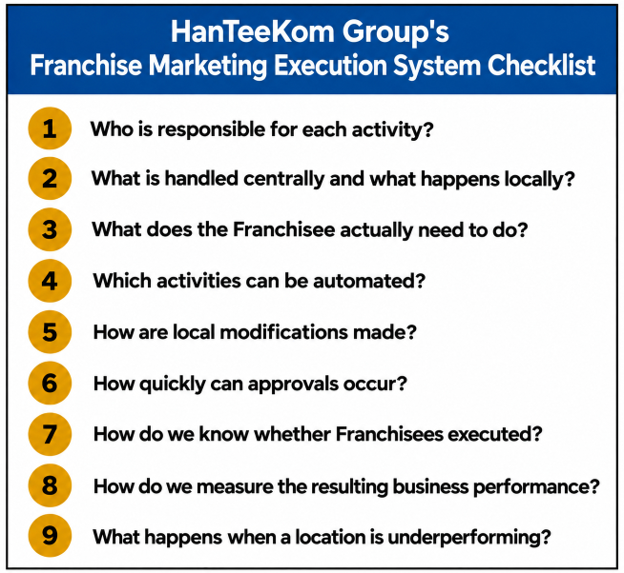
Some of these questions will be part of an evergreen system. Others will be part of a system specific to a campaign or a group of campaigns. Regardless, without that second layer, headquarters may repeatedly produce good marketing without solving the underlying execution problem. And adding more technology or media does not necessarily solve it. It just makes the problem of fixing it more expensive.
Technology usage and focused media planning should remove steps from execution rather than add them.
Measure Adoption Before Judging the Strategy
There is another consequence of the Franchise Execution Gap that is easy to overlook: it can distort marketing measurements.
Suppose corporate launches a campaign across 100 locations, and revenue increases only modestly. Was it the campaign? Perhaps. But what if only 55 locations executed correctly? What if 20 used only part of it? What if another 25 did not participate? Without measuring adoption, the organization may evaluate the effectiveness of a strategy that was never consistently implemented.
Franchisors therefore need to distinguish between at least two types of performance: (1) Marketing performance: Did the campaign generate leads, customers, traffic or revenue? (2) Execution performance: Did the Franchisees actually deploy the campaign as intended?
The distinction matters. If adoption is high and results are weak, the strategy may need to change. If adoption is low and results are weak, changing the strategy may simply create another campaign that the network fails to execute.
This is one reason franchise marketing measurement should increasingly connect corporate activity, Franchisee adoption and location-level business outcomes.
There is evidence of a broader measurement challenge. Recent IFA-sponsored research (2026) found that 75% of franchise marketers described themselves as very confident in their ability to measure marketing performance, while only 48% reported using analytics and reporting tools. More importantly, 57% of Franchise owners and operators reported substantially less confidence in measurement than marketers did.
That gap matters because Franchisees ultimately experience marketing through business outcomes: leads, appointments, customers, traffic and revenue.
What Strong Franchise Marketing Execution Looks Like
The objective is not perfect uniformity across every location. It is repeatable execution with controlled local flexibility.
A strong franchise marketing operating model should make it easy for a Franchisee to understand what is happening, what corporate is doing, what the Franchisee is responsible for and what results the combined effort is generating.
As explained below, at the most practical level, that generally requires: (1) A clear division of responsibility, (2) Simple execution, (3) Built-in localization, (4) Fast governance, (5) Training designed for operators, (6) Visible adoption, (7) Business-level measurement, and (8) Continuous improvement.
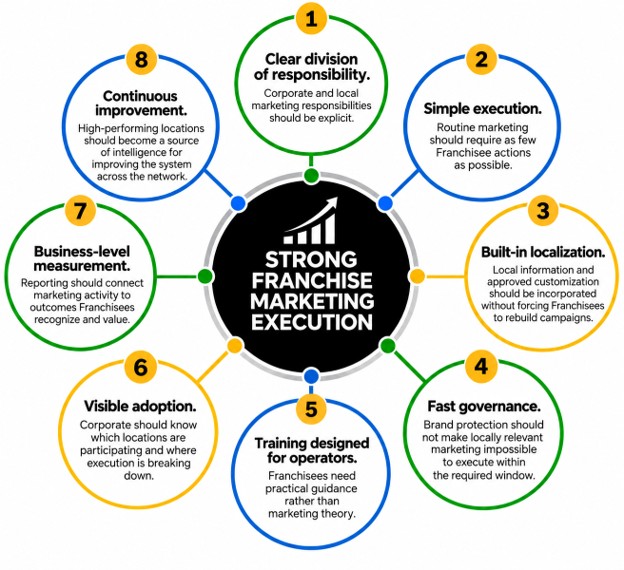
And Point 8 may represent one of the greatest opportunities in franchise marketing. A franchise network is not simply a collection of locations to which corporate marketing must distribute campaigns. It can also function as a large-scale learning system.
Different locations provide opportunities to identify which messages, offers, channels and local activities perform best. When that information is captured systematically, successful practices can be identified, tested and deployed across the network.
Scale then becomes an advantage rather than merely an execution challenge.
The Question Franchisors Should Be Asking
When marketing performance is disappointing, developing another campaign is relatively easy. Diagnosing why the existing strategy did not translate into consistent execution is harder. And more time consuming.
It requires looking beyond creative and media into roles, processes, technology, incentives, training, governance, measurement and the actual day-to-day experience of the Franchisee.
For Franchisors, that leads to a different starting question:
Do we have a marketing strategy problem in the campaign? Do I have a marketing execution problem in the campaign? Or do I have a system problem that is leading to faulty execution?
Because the best marketing strategy in the world creates very little value if it cannot consistently make the journey from headquarters to the local market.
About HanTeeKom Group
HanTeeKom Group helps Franchisors, Franchisees, and small to mid-market companies — both PE-backed and independently owned — plan and translate strategy into executable marketing and customer experience programs that drive top- and bottom-line growth.